Street Fighter is a long running franchise and many of it's characters have classic themes associated with them. Staple character Ryu always has the same theme, varied in many ways as well as many other characters out there. Super Street Fighter IV takes existing character themes, revamping and remixing them to fit with the new game, or making entirely new themes that stay true to the character they represent. Street Fighter has been known for giving it's characters their own themes all the time so it's no wonder they don't try to make entirely new themes for the characters because not all fans would agree with that sort of choice. Creating all new variations on the themes is the way to satisfy the fans and keep with the characters.
Every single character in the game has their own theme, not a single one left out in this version of Street Fighter IV. Many incorporating different styles and instruments to try and fit with the style of character, even culture of that character. Each of these remixes are all very good, though favouring them over the original versions is up to the taste of the user of course. Overall all of them are solid and great to listen to during the fights in the game. The character themes are more enjoyable to listen to then the normal background music that plays during the stages, but they themselves aren't bad, just completely overshadowed by the character themes.
Cinematics have been in games for a long time, since even the earliest days. They have always been an essential tool for helping to tell a story in a game but there have been different ways of using it. One of my previous blog posts covered real-time cutscenes vs. Pre-rendered cutscenes, which focused more on the technical aspects rather than the immersive aspects of them. In this blog post I want to talk about the different ways of using cinematics, first person or third person. When I say third person I usually mean in the typical fashion that is normally seen in games, looking like a film, taking the perspective of a camera watching the action unfolding in front of you. For example, you would typically see these in all final fantasy games. For first person, well it’s rather obvious, you take a first person perspective. The action unfolds in front of your very eyes and sometimes you have control, sometimes you don’t but you never leave the body of your character as they watch the actions unfold. This is typically seen in the Elder Scrolls, Oblivion and Skyrim clearly demonstrated this. So now let’s see what each of them offers?
Third Person
We’ve known these kind of cinematics for the longest time, they’ve appeared in far more games than first person style cinematics have. This is pretty much the default cinematic approach, to take the approach of using a camera just like a film would use. So that means it’s not exactly and original approach to take but many games can live or die by these. Bad cutscenes and poor camera work with these kinds of cinematics may make players want to skip the cutscenes and therefore lose immersion and interest in the story. Some games hardly focus on these, using poor camera work or no real camera work at all. These are the games that players want to skip over. Meanwhile other games such as Final Fantasy and Metal gear Solid show great camera work and cinematic quality, taking angles a film maker might want to take and shower great detail and care into making their cinematics worthy of film.
The long opening cinematic of Metal Gear Solid 4
Camera work and programming
Camera work can require quite a bit of effort, especially for in game cutscenes. Camera work needs to match the action on screen and a variety of effects (such as blurring) to help enhance the effect of the action on screen. Programming wise this means quite a bit of calculations and positioning to place the camera in the right places and at the right moments. A lot of timing is required and no doubt storyboards and some sort of process would be used to try and determine how the cinematics might look like. Not to mention Metal Gear Solid and Final Fantasy have a ton of cinematics all over the game (Metal Gear Solid 4 being famous/infamous for 30 min+ long cutscenes). A lot of care and detail is made into making the cinematics match the flow and tone of the game and make them interesting enough to watch. If it was just a static camera during every cutscene, people would be even more inclined to try and skip over them.
Mass Effect 2's opening sequence
The Experience
These kinds of cinematics create a film like quality, that some may or may not like. I for one enjoy cinematics of these kinds if they are done well enough. Certain series are able to offer consistently good quality to make these cinematics a pleasure for me to watch. There is a reason games need a team dedicated to cinematics if they are known for providing a lot of them.
Final Fantasy XIII-2 opening cutscene
So depending on the company and game, these kinds of cinematics can be rather bad if they can’t put a large enough budget or no effort into them. It makes them a bore to go through and gets one less engaged in the experience. If done right they can provide great dramatic moments that films provide and help tell the story in ways that normal gameplay wouldn’t be able to. Or can it?
First Person
These are the new kids on the block, not every game uses these and not all of them are good, but a number of them excel in making use of these kinds of cinematics. First off, to qualify as a first person cutscene is that, most of the control is taken away from you. You are still guided and have some input into the scene at hand but for the most part things will always lead the to the same conclusion whether you decide to act or not.
Skyrim's first person, opening cinematic
Actually there aren’t a whole lot that greatly dedicate themselves to these kinds of moments. I am looking at Skyrim, Call of Duty, Bioshock as my examples though, I can’t quite think of many others. I will take a closer look at Bioschock since it’s really the best example of this.
In Bioshock, there is not a single instance you are not in first person, you are always playing from the perspective of your character’s eyes. There are many moments where you can move around a bit, but ultimately you won’t be going anywhere until the “cutscene” is done. For example at the beginning of the game you take a device that transports you into the heart of the city of Rapture. You are stuck in this capsule the whole time but dramatic music and narration cues as the sights of the city come up in front of your view. It shows all the signs of being a cutscene while you’re looking at it from a first person view.
Bioshock's reveal of rapture
Bioshock consistently shows these cutscenes throughout the game, particularly in one instance where you...
(SPOILER)
Kill Andrew Ryan, the game’s antagonist in first person, not able to control whether or not you smash him with a golf club.
(END SPOILER)
This is a pretty solid representation of a first person cutscene. It’s going to happen, you can’t stop it but you can feel and see what’s happening first hand. You can even feel the vibrations in your controller from the blows being struck. Dramatic music cues enhancing the scene, makes it immersive and rather different than a third person cutscene. Done right these can be even more effective than their third person counter parts.
Another example of this is in Call of Duty 4. You’re trying to escape in a Helicopter from a killzone after rescuing a pilot because there is a potential nuclear threat. You think you’re safe until suddenly the nuke goes off and your helicopter is caught in the blast. You wake up moments later, dazed and the scene is a sickly red hue. Everyone around you is already dead and your controller vibrates as you feel your character struggling to move. The effects of blurring, shaky camera, and struggling breaths help accentuate the feeling of appending doom. You can walk around, try to make it out of the broken down helicopter but the conclusion is always going to be the same. You walk out, but no matter how far you get you collapse and look to the sky, dying.
The Experience
It was a dramatic moment that players didn’t expect when they first played the game, and it was pretty powerful at the time. The fact that you played and viewed this in first person the whole time made it definitely very dramatic and even better than it could have been done in third person. Why? Because well we hardly knew this character to be honest, so if he died in third person who would really care? But the fact that it was done in first person made it a lot more impactful, because it was like you were embodying the character as well and you were dying. Not to mention the various effects that helped enhance the scene (The blurring and staggered walking would not have worked as well in third person). This is a very solid example of how well cinematics in a first person can work, done in a way that a third person cinematic would not be able to replicate.
Call of Duty 4's immersive ending
Camera work and Programming
In terms of programming, this can be rather difficult to get done right. You need to have certain camera work still, shaking the camera to replicate the first person view. You need to make sure all the objects are at a certain perspective and position so that it will make the most out of the view. If these are out of place it can make the view just look bad and not be very powerful. If the camera is not shaky enough to represent both the viewer and the effects on screen (Such as massive explosion), the viewer won’t feel like they are experiencing it and it will just look bad. Getting the camera movements right in this mode is essential for any game striving for first person cutscenes. If they are done wrong it completely ruins the experience because in my experience I have not been able to skip them. And you should not be able to as well since they are first person, but people could be rolling their eyes if they are simply really bad and non immersive experiences. It definitely has more risk than third person cutscenes, which is probably why there are way more games that just focus on trying to use third person cutscenes.
Conclusion
Not one method is better than the other of course, but overall there is less risk in using third person methods. Because it allows players to simply skip it and can still use lower quality camera work to function properly, it can get players right back into the action. Or they could put a lot of resources and make every cutscene a great cinematic experience to draw you in the story, you have either option really and you can put as much coding effort as you want or don’t want. Also to note is that any game can use third person methods as well, even if it’s a first person game. You can use these any times.
First person is more limited because you typically only want to use it in a first person game. There can be times when it can be executed incorrectly and just be boring, but in general it’s not that hard to make it not that boring. More and more games seem to be using it, though only the best can truly immerse the player in the experience. Coding can be a finicky issue because some games, such as Half Life 2 allow the player to move around fully during important events where NPCs are talking. This requires coding for the NPCs talking and lip synching but no camera involvement. This make it easy to code for in that sense but does this really count as a first person cutscene? Some might argue it does since it’s still a cinematic experience, while others might say it’s less engaging. In any case, coding can take the same role as third person, because there can be those moments like I just mentioned in half life where it can be easy to code, while there could be more complex coding in first person sequences such as a cinematic view during Bioshock.
Weighing in overall experiences involving watching and experiencing cutscenes, overall I have to say that coding in third person cutscenes can be harder. The way they are both coded are different and provide different experiences, but overall you have more flexibility in making interesting cinematic shots in third person, while first person can really immerse you if done correctly. But you are of course limited to that first person perspective, which should give you less potential options for complex cinematic shots. But I am not going to say one is better than the other. They both provide great experiences when done correctly and they both provide different experiences. First person is more unique because it’s used less and can pretty much only be used in first person games (with some exceptions I can’t think of currently but I know they are out there). Third person can provide great cinematic experiences though they are used much more commonly. They are both necessary for our games and I’ve enjoyed a variety of both types of cinematics.
Bayonetta is a rather peculiar game but an excellent game nonetheless. The overall look of the game is, for lack of a better term, very exaggerated. The game's titular character Bayonetta has greatly overdone proportions but done so purposely. The game has themes of light and dark throughout but mixes in rather cheery, almost pop-like music at times but it somehow all fits. Bayonetta's remix of the popular song written in 1954, Fly to the Moon is not something you would normally see in a video game, but somehow with the overall tone of the game it manages to fit in the sequences.
The game's protagonist and playable character, Bayonetta
Because the game doesn't take itself seriously, it knows it doesn't want to be serious. It of course has some serious moments, which are quickly subverted later on and brought right back into light, cheery moments that this Fly me to the Moon rendition extenuates. You yourself are actual a witch, someone of the dark side so you essentially fight against creatures of light. It subverts light vs dark by putting you right away in the shoes of someone on the dark side. Not to say you're evil, in fact it is the light side that is "evil" in this game.
I am explaining how the game works so that the challenge itself will be understandable. Note: The only gameplay of mine is in the challenge video near the end of this blog.
Gameplay basics
On an actual gameplay level, the game is brutally difficult when it wants to be. You play as Bayonetta in an lighting paced action platform. You need very quick reflexes and be able to anticipate attacks by opponents because they can be very fast at times. Your controls consist of a jump, 2 attacks that can be combined with certain timing and directional inputs to form powerful combos, and most importantly the dodge button (on the right trigger).
Gameplay from the japanese demo
This is the most important tool in your arsenal as it allows you to dodge most enemy attacks. Most enemy attacks, if dodged at JUST the right moment will trigger "Witch time". In witch time, time is essentially slowed, it's easy to see by the purplish tint to the background as well as a clock sound ticking as well as actual clock bordering the edges of the screen. During this time all enemies will be slowed and you can unleash your devastating combos on them. This is the most satisfying mechanic in the game as its truly necessary in order to defeat many of the bosses as it will be difficult to damage them at all without this mechanic. The concept of slowing down time in action games isn't new, but Bayonetta executes it so well and keeps the pace of the game always frantic and fun with it. It's completely necessary to have this mechanic in the game at least for the normal difficulties as it truly brings in the player with it's constant rewards.
Boss battle against Fortitudo, one of the first bosses
The appeal of the game is also in it's rather fantastic boss battles. You fight a variety of different giant creatures (I am not familiar enough with biblical symbolism to realize what they each represent) but they all represent something from the bible I am sure of it. Creatures range from enormous two headed dragons, to serpent like sea creatures, to giant mechanical monsters. The design of the creatures is part of their appeal as I haven't see anything quite like them. They are all representing creatures of light, but twisted in various ways and have a certain look that makes them stand out and say "We are in Bayonetta, not in any other game". The boss music in each battle complements the intensity of them all and in particular the one I will showcase has the best music in the game in my opinion.
Combat and Combos!
So what keeps one hooked to the game? Well for one the combat is always evolving, you are always unlocking new abilities and combos. You can of course stick to one combo and use that throughout the game but it's actually way more fun to experiment with new combos you've learned and combine them to create some truly flashy and amazing looking combos. Other abilities you get to purchase, some that will increase health, magic meter (Which can help use various abilities), purchase new types of weapons, abilities to turn you into cat form or bat form, some that will let you use witch time without having to dodge, etc. There are a ton of different items that will be able to change the way you play at any time and it really makes it fun to experiment with.
Explanation of the Witch time mechanic
The weapons in particular are actually all quite different, each one providing different attacks, different power, speed, etc. You even get to mix and match different weapons on your hands and feet, giving you many combinations of weapons to play with. It’s this experimentation along with the increasing difficulty that makes the game really fun, it can be punishing at times but it’s a whole lot of fun to play and as you get better, it’s possible to go through entire levels without getting hit if you’re good enough.
An example of a slick combo a player was able to perform
Various items will also give you boosts such as absorbing one attack, slowing down time, etc. These cost magic meter which you have a limited amount of but can increase how much of it through upgrades. The only way you can get this matter meter is by consistently dodging, you don’t gain any from hitting enemies. You also lose a large amount if you get hit, so essentially your aim to do good in any level is never get hit, which is of course easier said than done.
Difficulty system
The difficulty system works rather typically at first, enemies get stronger and faster, though they don’t necessarily get more health. In fact I am pretty sure they don’t. It’s actually a really good difficulty system in that sense because in this game they don’t necessarily have to get smarter anyways, but for some bosses they actually do because they will learn how to dodge your attacks as well. The faster attacks, having to worry about a lot of enemies at once is always nerve wracking when they deal a ton of damage but so, so fun. Also to note is that the pacing of the game is excellent, there aren't any major difficult gaps suddenly (at least not that I noticed) although there are some hard enemies, it always possible to get by, by healing yourself (Though it will make your rank suffer, which I will explain later).
Temperantia, a towering golem like boss
The neat this is when you get to the hardest difficulty Non-Stop Climax (This is SUPPOSED to mean something dirty, intentionally), that one of the most important parts that has been with you in your journey throughout the other difficulties. Your dodge, no longer triggers witch time. You now have no way of slowing down the enemy apart from one item that will allow you to use witch time. This means you have to now face faster, stronger enemies while relying on no witch time at all. If you thought it took forever to kill an enemy before, try it without witch time to allow you to combo. Enemies won’t get staggered as much from your attacks as well (Also because the hardest enemies will replace the easy enemies even during the early levels and they in general don’t get staggered as much). This means you have to attack, dodge, attack, and time it right or you could lose 1/3 of your life from a hit. Even harder is the fact that there are more enemies in every area, as well as how I mentioned the harder enemies replaced the easy ones. It It’s brutal but it’s even more exciting than the other difficulties if you can keep up with the action.
Sapeintia, the sea boss. You get to fight it while surfing!
Luckily like I mentioned there are items that can still help particularly for this mode. The item that can block hits will be essential, the one that can trigger witch time will be, one will actually replace witch time with creating a sphere of energy that can deal a good amount of damage to your enemies. This item in particular is essential to beating the mode, since you need every bit of damage you can get on the enemies, this is your key to survival.
Ranking system
Example of a gold medal
Now, in Bayonetta you are ranked in every level (stage) based on how you performed. The catagories are how long it took, the amount of points in chaining combos you were able to perform, and how much damage you took. These can be rather difficult to achieve based on the stage. If you get all three platinum rank then you get a pure platinum medal for the level. Various combinations of different ranks in each category will change your changes of different medals, but it goes from stone, bronze, silver, gold, platinum, pure platinum.
The Challenge
Now, I’ve explained just how hard and fast paced this game can really get and how the ranking system works, so now I can get into the challenge I made myself. Now the last time I played this game was apparently in December 2010 according to Xbox.com. I myself doubt it was THAT long ago since I probably tried to replay it before. But let’s just say it’s been a fairly long time since I played the game, over a year. My challenge is to see how long it will take me to get a platinum medal on one of the last boss stages.That means I am allowed to get hit once or twice, fair, given the pace of the game. I am going to go on the hardest difficultyand see how many tries it might take me to get the platinum medal I want.
Last time I played apparently at the end of 2010
Now I've played again in 2012!
So enough talking, let’s see how long it takes me to get it and if I still have the skills I once had in Bayonetta!
Watch me take on the challenge after over a year of not playing!
Conclusion
It looks like it didn't take too many tries to beat the challenge. I was hoping I could get it in the first try but wasn't quite up to it. Oh well!
Bayonetta is by far one of my favourite action experiences of all time, in fact this game is one of my favourite action games of all time because of the entire pace of the game. It’s just so darn fun and exciting, brutally difficult at times but so exciting. Going for the platinum or pure platinum medals was always engaging and fun due to the rapid pace of the system and the amount of combo potential you could have. If anyone hasn’t played this game I suggest you do, it’s a game that any action fan needs to try. Note: (By the way the boss I fought won’t give any spoiler alerts despite him being near the end of the game).
Once again this blog needs a bit of gameplay to spice the place up again. There haven't been many games I have played in the past while that are that interesting to get footage of, or I just never thought about it. Either that or I have just been too busy to really play, let alone worrying about editing and capturing footage to. I immediately got back into trying some more Soul Calibur V since I hadn't played it in a couple weeks and stepped once again into the online arena.
My experience with the online system has been consistently good and without lag. Soul Calibur V represents one of the best online fighting experiences I have had the pleasure of playing. There is little to no input delay which is key to the fighting experience. The game itself provides various options to enhance searching for opponents, making it easier to get right into the fight against the right level of opponents.
Natsu, the character I've been using most recently in Soul Calibur V (Featured in my matches)
I know that I have a lot of fighting game experience and I know I am still not too great at certain fighting games. I personally believe my knowledge of Soul Calibur V is decent enough as I can still apply the same "mindgame" mentality that all fighting games require. I know how to use some of the tools that my characters have and try my best to learn new techniques and match ups as I go along. So as I play online I am still increasing my skill level through experience.
That said I can't say that my current rank is truly representative of my skill. You gain rank just by winning and you lose points of rank when you lose. So to reach the rank that truly represents my skill, I have to keep going farther and farther. So far I've managed to get by 30 games or so without losing and I don't know if that's just because I was able to get more practice in (The character I have used in the past wins I have not used all that much) or just because my opponents are not that good yet. The 30 games won means that I am still gaining points consistently, very consistently so I am still not where my rank really would represent me. I for one don't believe the ranking system in the game would truly show your skill though but it tries its best to. I did have a few close fights in the matches I am posting so that's always good to have.
Oh well we will see how things go in the future, whether I will keep winning till I reach a certain rank where I lose and win a more even amount of times, or just keep going higher and higher above that.
I will admit, I have not yet played this game or any in this series in fact. Xenoblade Chronicles is part of a gaming series, the Xeno series. This game, Xenoblade Chronicles takes place in a different universe than the rest of the series but like all of them it is an RPG. The game itself is a action rpg though, taking place in real time. So far it's been released on the Wii to critical acclaim all around the world, except for North America. Luckily for us we are getting this game in a few months. The announcement of the game got me interested in what the game's soundtrack might be like and I was surprised.
The soundtrack is quite phenomenal in my opinion, without even the context of the game to go along with the background music, it still sounds very good. Most games when we play then and hear the music, we then associate our memories linking the music and the event happening in game. This game's music doesn't need to link to those experiences because it already sounds so good. Hearing the music gets me anticipated to get my hands on the game because it's quite a pleasure to listen to. I won't ramble on any more about it since I still don't know all that much about the game but trust me when I say the game's soundtrack is strong enough by itself.
Back on the N64, the first Super Smash Brothers game was released late in it's life cycle. The game combined iconic Nintendo characters into a unique, party fighting game for up to four players. It essentially spelled fan service for any Nintendo fans and lulled them in with it's cast of characters and fun gameplay.
The success of the game brought about it's sequel Super Smash Brothers Melee, to be released along with the Gamecube. The sequel made the gameplay even faster, more varied, gave a larger cast of characters and upgraded the graphics substantially. It was a pretty huge leap in every single aspect, making it one of the best selling Gamecube games of all time.
Fans clamored for a sequel for years after, however it's creator Masahiro Sakurai had left Nintendo in 2003, which meant the future of Smash Brothers wasn't as bright. Thankfully he joined again exclusively to work on bringing a new game in the series to the Nintendo Wii. Brawl was announced in 2006 and later released in 2008 in March. The game sported an even larger cast of characters, gameplay refinements and a massively expanded roster of stages. Visuals in the game were increased further though perhaps not to the extent Melee changed from the original game. They were nevertheless much better still. Well that is the history lesson about the franchise, let's see how it changed from the beginning?
Super Smash Brothers (N64)
The N64 was about midway through it's life cycle by the release of Super Smash Brothers. The development team Hal Laboratories was a subsidiary of Nintendo's, meaning they would have access to all the knowledge they needed with the system in order to try and make the game run and look as good as possible on the system. Unfortunately they didn't have many other games released on the N64, meaning they didn't have full experience in optimizing for the system. This meant the game was probably not as pretty as it could have been if it had been at the end of the N64's life cycle.
Hal Laboratories, lead by Masahiro Sakurai for Smash Bros.
The game was also not given a large budget, and was supposed to be intended only for Japan. This meant that they wouldn't have as many resources to put into making the game look as nice as possible as well. Fortunately for us, the game was a success in Japan and soon saw promotion World wide, of course they didn't improve the graphics despite the localization to other countries.
Some important things to note about the N64 is that it had a limited texture cache of 4 KB, which limited the size of the textures they could put onto any of the 3D objects in the game. If they didn't use textures, some games would use Gouraud shading (which would shade the plain colored objects) to try and make up for it.
Character select screen, the characters do not have too many textures on them
The game is a meld of 3D and 2D. It combines 3D character models, 3D arenas and 2D sprites in the game world. Characters appear to have a combination of minimal textures and shading (not sure if it's specifically gouraud shading or a simpler type). For example, if you take a look at Kirby, he is simply a colored object, and his face is just a texture on top. Same with pretty much all the characters, you can see they are pretty much solid colors all around with some textures every now and then. The M on Mario's hat for example would be a texture on top. Also to note is that the 3D models themselves are all low polygon, it's easy to see the vertexes on everyone of them. Not surprising though considering its the N64.
More effort went to making the stages look nice at all distances
Most of the texturing seemed to have went into the stages themselves. Since they are so vast, they would have wanted the stages to look their best while their characters would still look fine with less texturing. They would have needed to do this due to their limited texture cash. It works out because you can be rather zoomed away from the characters anyways but the stages still must look nice. The characters still look decent enough in their minimal texture form while the look of the game would have definetely suffered had there been very flat colored stages.
The heart on top right side of the screen is a 2D sprite that animates
The stages were 3D but there were also aesthetics, floating sprites in the background to try and make the stages look more alive. Using these 2D sprites in place of 3D objects that were textured would save memory and still look decent enough. The backgrounds of stages aren't the only thing that do this. A majority of the various items characters can pick up were also 2D sprites. Other effects that occurred, such as when hitting opponents, fire effects were also 2D sprites. In fact pretty much anything that could be considered particle effects were 2D sprites, none were 3D objects.
Notice the 2D sprite resulting from Link's attack on Samus
You can see the 2D sprites of fire on the characters
The game itself was rather slow, the frame rate was definitely not high at all. It had a rather low frame rate on the Nintendo 64, however Virtual Console versions and Emulated versions of the game run faster. The reason it was slower was due to the power of the Nintendo 64. It's not surprising though since the game had a limited budget and they needed to cut corners so that the system could handle the game.
It definitely wasn't the prettiest game on the N64 but it faired quite well with the resources it had. But it was successful anyways and led to fans demanding the next game in the series. With the release of the GameCube, the development team was handed a much larger budget due to the success of Smash Brothers. They would also have the power of the Gamecube to work with, no longer strained by the limitations of both their smaller budget and the power of the N64.
Super Smash Brothers Melee (Gamecube)
Super Smash Brothers Melee was released as a launch title along with the Nintendo Gamecube. Since it's release it's had over 20 million copies sold, making it one of the most popular Gamecube games of all time. In general, Melee was a huge change over the N64 in terms of well, everything. From graphics, to physics, to gameplay, everything was improved in every possible way.
Every aspect of the Gamecube was of course superior to the N64, more texture memory, better video card, better sound card, more RAM, etc. The development team was even larger now to work on the game and they into taking full advantage of everything they could now.
Both Fox and Link's models were vastly improved
Every character model was much mode detailed, boasting a much higher polygon count. The models themselves were no longer limited to the limited texture memory of the N64, they could now give every character actual textures to define their outfits and look. Animations improved massively over the original's as well, most characters boasting entirely new animations for every attack they had. Their motion was much more fluid and realistic. Overall the characters looked way better in every possible aspect, I don't think there was much more they could improve.
Hyrule Temple, one of the largest stages in Melee
The stages looked much better, they were better textured now, and gone were the 2D sprites hanging in the background. If there were any sprites, they were blended perfectly with the 3D environment. Particle effects littered the stages as well, most notably the Final Destination stage, where you can see all sorts of particle effects flying.
No items, Fox only, Final Destination
The particle effects were refined greatly and though some remained 2D sprites (such as when hitting an opponent, a star like shape appears), much of it was 3D particle systems and if there were 2D, blended so perfectly into the visuals that you hardly noticed. This was not the case in the original were all the 2D sprites were pretty obvious. Lighting effects were of course enhanced as well though they decided with a subtle lighting, not making any hard shadows appearing on characters or environments. It is more basic lighting than anything too fancy, though its easy to see the sheen on some characters such as Yoshi.
The improved particles in Fox's lazer. In the original it was just a pink line.
The physics of the game have also changed. Not all characters fall down the same, some float down slowly (Kirby), while others can fall extremely quickly (Fox, Captain Falcon). The original didn't have this difference and helps to make the game more dynamic and interesting visually since the characters match how they might fall in their games or due to their weight. Another nice aspect they did to enhance the game and overall make the game faster since all characters in general fall faster compared to the original anyways.
Captain Falcon is one of the character's who fell REALLY fast
With the larger budget, they showed a lot of great looking visuals in the games, whilst maintaining a 60 Frame rate. You can tell this game is 60 frames per second, it looks so smooth in comparison to the original and never skips a bit. The only time you can lower the frame rate is by attempting to the glitch the game (aka, using the Black hole glitch). This glitch by the way results in crashing your game and forcing you to reset the system. Otherwise the game always runs smoothly and really makes the game shine, only making it's rise above the original even more fantastic.
Super Smash Brothers Brawl (Wii)
With the massive success of Melee, it eventually lead the the rise of Brawl. The game was not as large a step visually as Melee was over the original. It was still a leap, though not nearly as great. Nevertheless the game still showed great improvements in it's visuals despite the Wii not being significantly more powerful than the Gamecube.
Link's improved Brawl model
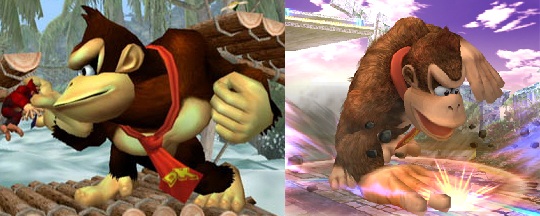
For one, the textures were significantly improved across all characters. There was still some amount of lack of texture for specific characters (such as Pikachu and Kirby), though to be honest they still lack it in Brawl. That's probably due to the characters themselves, they don't even need textures. However Mario on the otherhand has more detail in his overalls and shirt, Link has much more detail in his shirt, pants and boots, Donkey Kong actually has real fur popping out (potentially bump mapping and particles) rather than just a texture over his model.
Comparison for Donkey Kong Melee (left) Brawl (right)
Comparison for Samus Melee (left), Brawl (right)
The look in Brawl defines the characters even more and certain properties, such as the metallic property of Samus' armor, in Melee it looked metallic somewhat, but not greatly metallic. In Brawl it truly does look metallic and defines her look greatly. Same for many other character's who's clothing properties now look much more defined than they did previously. Overall lighting and shading of the characters is also improved greatly which helps with the same defining of their outfits.
Watch the background of the stage, it synchs perfectly with the music and provides a great amount of cool particle effects
Stages have been improved quite substantially as well, many boasting many more visual aesthetics running all around in the background. The overall texture of each stage is also greater as well and particle effects run amok all over the stages. There is not one stage that looks bad and many of them look absolutely spectacular, knocking out all of Melee's stages in terms of look. Specifically the Final Destination stage in Brawl features a massive array of particles that look absolutely spectacular, one of my favorite things to see on the Wii. Even though its not full HD, it looks great.
Zelda has changed significantly since Melee
Overall physics have changed, everyone is once again more floaty when falling down or getting knocked around. This was a design change mainly for gameplay and in my opinion slowed down the pace of the gameplay unfortunately. Nevertheless the actual physics in more aesthetic ways is improved. Hair flows around even more realistically than before. For example, Zelda's hair in Melee was basically a solid object being moved around by animation, where as now it looks like it flows naturally with the character.
Mario's Final Smash
Like I was saying about the particles in Final Destination, overall particle effects look better in Brawl. Most of them looking quite a bit better in fact and simply adding more to the game. In fact due to the inclusion of the “Final Smash Abilities”, there are many more lighting and particle effects going on due to the enormous power of the attacks. Glowing auras, insane fireballs, glowing tri forces, giant hyper beams, particle effects get insane in this game. I go back to my point and say particle effects actually look insanely good for a Wii game and are way better than they were in Melee.
Link's Final Smash
Like Melee did before, Brawl runs at 60 frames per second. The Wii wasn't supposed to be that much more powerful than the Gamecube, yet Brawl's textures look significantly better, Particle effects and Lighting look amazing, there are even more stages, characters and visual aesthetics in the game, the aesthetic physics look better. Despite the Wii's limitations, they managed to make Brawl look insanely good, honestly one of the best looking games on the Wii in my opinion. Somehow they've managed to take all these iconic franchises, meld them all together seamlessly. Even incorporating third party characters like Solid Snake and Sonic, making them look great and fit in the game still.
I'll say although it's not as huge a leap as Melee from the original was, Brawl still looks really great. I am pleased with the changes they were able to make to it's engine.
Conclusion
Long live Super Smash Brothers
So there we have it, Super Smash Brothers has evolved quite a bit over the years in terms of look. More impressive is how they managed to catch the look of all the characters perfectly, model and create them all for this game, animate them to move exactly how they should in their respective games and make a ton of stages that match all the franchises to. I haven't mentioned the huge amount of composers it took to make Brawl's music too. This series is one of my favorites and it's really nostalgic to see how it's come from it's release in 1999. I can't wait to see what the future holds in store for Super Smash Brothers (Which has been announced to start production on the Wii U).


-5.jpg)
-6.jpg)
-4.jpg)