Showing posts with label infr3330. Show all posts

Saturday, November 17, 2012

MIGs 2012 - Trip Experience


Just this week from November 12 to 15th, the Montreal Internation Game Summit took place. Developers from all over the world ranging from programmers, game designers, artists, audio technicians and even the CEOs and executives of companies came to meet over the course of these days. Some even gave very useful presentations about their field of study that would unveil new technology and techniques to either market their own company or help audience members for their feature endeavors.

The Trip Begins


A trip for UOIT students was formed and I was among the students taking the trip to Montreal, leaving on the 12th and leaving home the night of the 14th. We spent only two nights there, being at the conference for day 13 and 14 which were the most important days anyways. We took the 6 hour long bus ride to reach our hotel on the 12th and pretty much spent that day exploring Montreal. The tickets we had purchased did not include the 12th or 15th in it's admission so we would not have been able to get into MIGs for that day.

The first night concluded and the first real day of MIGs began. We spent a 20 minute walk towards the hotel in which it took place (though we got lost the first day) and came late to the first presentation. The first presentation came from Tim Sweeny, the CEO of Epic games in a talk about Challenges of the Next Generation Consoles.
Highlights included a speech from CEO of Epic Games Tim Sweeney

On a side note I want to state that there are lot of important game industries people here at MIGs (though perhaps not as much as there would be at GDC). Tim Sweeny is the CEO of Epic Games, developpers of Gears of War and Unreal and they are a very powerful company for both making games and developping tools for making games. Other speakers included Peter Molyneux, formerly with Lion Head Studios and created Fable, Black and White and other games.

Going back to how the day went, I missed the entire first lecture since I had to help my friend Mr. Freeman who did a problem with tickets. I then split off to go to the lectures I wanted to look at. I was very curious about a lot of the art related topics interestingly enough. Though I pretty much mostly focus on programming in Game Dev, I am still extremely interested in art, perhaps more so than programming.

A quick note about the presentations is that every time slot is an hour. Also there are always 5 other presentations going on at the same time so that means I missed some other presentations I wanted to go to due to conflicting time slots.

To get an idea of the presentations and topics covered, look here! 

The Presentations Begin - Day 1


The first lecture I went to was "Drawing Inspiration" Bringing Characters and Worlds to Life" by Samantha Youssef. She works at Disney now and went to Sheraton College in the art program, being the only one from her year to be hired by Disney when she graduated. Her talk was incredibly informative regarding art and it was very useful as it opened my eyes to some new techniques she talked about (and she was pretty). I took notes as well and I plan to do a personal write up about this topic and some of the other topics later.

Then came lunch break where I explored the rest of the show floor, but before that I will go over the presentations I went to first.

Guild Wars 2 artwork from Lead artist Kekai Kotaki (now at Bungie)

Amongst the other presentations the first day included Kekai Kotaki, the lead artist who worked on Guild Wars 2 and worked on Guild Wars 1. Unfortunately his presentation got shafted as he was supposed to be provided a tablet so he could draw live for us and teach us techniques. Instead he did not get one and was forced to simply go over his existing work which was still interesting but kind of dry since he was not prepared for this event.

I then went to attend a programming presentation, one on GPGPUs which should interesting since it regarded the use of GPUs for more uses but the delivery was very dry and kind of boring so I almost fell asleep unfortunately. I do not remember much from that presentation and if I had been less tired at that time I would have absorbed more information.

Square Enix featured their new Glacier 2 Engine

The most interesting presentation followed, a look into Square Enix's Glacier 2 engine. I have already made a write up of my impressions of the engine here. To sum up that experience, seeing a AAA game engine close up and learn more intricate details and its features is awesome.

I pretty much ended my day there even though there was one more presentation that day since I was probably going to fall asleep in the next presentation

The Presentations Begin - Day 2

The first presentation I went to was the earliest slot, with a keynote from Peter Molyneux. We got in a little late once again and he talked about "Experience and Innovation". It was a little strange though since he was there via Skype call instead of in purpose. Apparently his new game "Curiosity" became so popular it had a server crash and he needed to stay there. He pretty much talked about Curiosity, how it works and a look into the office where the studio works.

I went to a presentation on audio afterwards which I unfortunately fell asleep in. Not because the presentation was boring, in fact it looked really interesting, but I was kept on too late the night before and got very little sleep. Sadface.

RAGE - Featured in the Art Direction presentation

Following that I went to a talk on Creating and Art Direction Visually Successful Games by Stephan Martiniere, who was lead art director for RAGE. It was extremely informative and in fact related highly to game design surprisingly. A few key points about it for now is that he was designing environments the NPCs themselves could inhabit and the environments would reflect in their outfits. I.E. a tech city would have people in more high tech looking outfits. It was a mesh of visual design being coherent to the world of the game and being immersive. The talk was so interesting that I will probably have a write up on that later on.

Details regarding Battlefield 3 Cutscenes and use of Facial motion capture were presented

Afterwards I went to a presentation regarding Voice Acting/Performance Capture, featuring Battlefield 3. The presenter Tom Keegan talked about the use of motion capture needing a lot more physicality now as the actors need to be able to act naturally and actually envelop the character for more natural movement. So an actor playing a soldier would need to hold a rifle and move around like they were doing it. He even talked about having all actors in at once to do a scene versus voice actors just going on different days and doing their recordings separately. It was an eye opener into some of the techniques they use for MO-Cap acting.

One of the most interesting talks of the day came from David Lightbrown, recently hired by Ubisoft Montreal for designing user interfaces. The talk was about "The Art of Creating Efficient Tools" and was actually VERY interesting and very well done. The presentation itself was the most engaging out of all the of them, he actually used the audience, he was funny, his presentation wasn't heavy on text and used simple shapes to engage the audience. This is one of the talks I am going to write about in the future but essentially it was all about developer tools that are so well done that they will reduce the work time to learn them and just use them to create content.

The final presentation came from a combination of a lot of speakers talking about how they think the future of gaming will come about. Some were more serious speeches, while others were more light hearted. It was interesting to see all these people talk on stage within an hour and everyone had a different opinion and topic they coverered. With that, the MIGs trip ended and we took the bus home!

Extras, Extras!


In my lunch break time and time I didn't spend in the presentations, I looked around the rest of the show floor. There were several booths for many companies, from Game Development studios, to Colleges and programs that specialized in teaching Game Development. Amongst them included Eidos (Deus Ex: Machina - Human Revolution), Ubisoft Montreal (Assassin's Creed III), Bioware (Mass Effect 3), and several others I can't remember. At these booths you could meet with the representatives of those studios and get contacts for networking.

Ubisoft Booth

There was also several others areas such as a demo booth which developers of any sort (including indie) could get space to display their new games. Another area was the art gallery featuring art submitted by people for a small fee to be displayed and voted on. The winner would get a prize of some sort (I have no idea what that prize could have been). There were two catagories, one for pictures which included 2D concept art, 3D models, illustrations and another catagory for video. The video could be trailers, or some artsy looking cutscene. Some people even submitted just a piece of music they had composed themselves.

The Sketch Duel area - Participants are focusing intensely on making their art

To top off this area, every now and then they would have a sketch duel. The first day featured professionals going head to head where they would have 15 minutes to draw something based on a randomly generated template. It could be something like "Draw a samurai dancing beside a house", which they would have to agree on. After the 15 minutes the audience would vote on the favourite. The same rules applied then next day when non professionals were allowed to enter and I watched the entire thing to see their technique. It was mostly speed painting and was another good motivator to learning more art.

Unfortunately I forgot to take many pictures and I should have gotten the art gallery...

Final Notes

So that was pretty much the MIGs trip in a nutshell. It was a really fun and interesting experience, something I would love to do again. Next year I plan to have my portfolio all ready, business cards ready and improve my art experience so I can have a chance at winning the Art Gallery. The presentations were definetely interestin and I learned a lot from them, so I will definetely check them out again.

Stay tuned for more posts for MIGs. I will probably have the following topics covered in more details in the future.

  • "Drawing Inspiration" Bringing Characters and Worlds to Life"
  • "Creating and Art Directing Visually Successful Games"
  • "Art of Creating Efficient Tools"

Monday, October 29, 2012

Basic AI Systems - Pattern and Dynamic AI

A major factor in how believable the game world is, comes from the AI system. When you think about it, almost every game has AI in one form or another. Even a simple game such as Super Mario Bros. has AI,  very basic AI that follows the same pattern. Nowaways we have highly advanced AI, like the ones demonstrated in the Halo series, renowned for their AI. There are varying types of AI, they can be set patterns or they can be dynamic and changing based on the state of the game. The type of AI used is dependent on the type of game being made.

For my post about making a Basic AI Behaviour, click here

Pattern AI


At it's core, a patterned AI doesn't care about what the player is doing, it's not going to react specifically to you if you happen to be jumping, attacking, or dodging. The most they might react is if you happen to be near, it will activate their AI. This is the kind of AI that was featured a lot in games in the 90s and earlier.

The most basic versions of these come in the form of goombas in Super Mario Bros. Their AI pattern is to just walk ahead and if they run into an obstacle turn around. These enemies in particular don't care at all where you are.
Super Mario Bros - World 1-1 ~ The Goomba AI literally just walks forward

Another rather basic AI is the AI in turn based RPGs, notably Pokemon (the old games). They pretty much have no AI. Where pokemon will have a list of four moves, in most battles though they will simply use them at random, with no thought to strategy. Later games started to implement actual patterns in battles to make some good strategies but they were still mostly patterned.

Pokemon Red - The AI used to just randomly use whatever attacks where in their movelist

Saturday, October 27, 2012

Dialogue in Games

How does dialogue enhance the experience of a game for us? What are it's advantages and it's disadvantages? What are the different ways we can go about bringing dialogue to life and bringing story to the players? As a follow up to my previous blog I want to talk about the difference between dialogue with audio, dialogue without and even games that feature no dialogue at all to convey the story.

Story has always been an important part in some games. A lot of games still have story of some sort even if they have no cutscenes or dialogue. Some games simply feature a "story" button featured in the main menu or something of the sort (though that's usually for flash games or lower budget quick games). For titles with larger budgets they usually have either cutscenes with dialogue & voice acting, cutscenes with only text dialogue, or the rare no dialogue and no text ones.


Action Only


These aren't too common and it's very important for these kinds of cutscenes to convey all the emotion and the messages they need with only character motions. It becomes very hard to pull this off for certain kinds of games, such as RPGs which usually have the largest of backstories. However there have been some very notable successes that have proven that you don't always need talking and text to convey what's going on in a scene.

The best example I have experienced of this is the Lego series games, such as Lego Star Wars, Lego Batman, Lego Indiana Jones, etc. In these games, the Lego characters do not talk at all but they have to re-enact scenes from the movies or settings they are in as though they were mimes. They are able to provide and make the emotions obviously in certain scenes such as worry, happiness, laughter, while still trying to stick to the character they are playing. They also have to use a lot of exaggerated gestures to convey more emotion as well.

Thursday, October 18, 2012

Sound is important! ~ Audio in Games

We often take for granted the sound we hear in games. As our professor Bill Kaprolos taught us, sound is often a neglected part in games. Not just by designers at times but also by players as well. How often is it that people will play a game without the sound or replace the game's music with their own. Designers adding in sound in the last few months and thinking of it as an after thought. Not everyone does these but it's not uncommon for it to happen. For this post I'm going to take a look into how sound, from music, to dialogue, to sound effects and ambiance affect the game. I believe that a truly great game will have great sound to make it a truly complete experience.

Sound Effects


These are the bread and butter of pretty much every game now. These define the sounds your enemies and players will make in the world, the environmental reactions to your actions. This ranges from things such as character footsteps, sword slashes, gunshots, explosions and anything that is resulted from an action or visual change in the environment. It can be a scripted sequence like a bomb going off and setting off that explosion, or your character holding a gun and you, the player making the gun shoot by pressing the trigger.

The reason these are so important is because they are something you will hear a lot during your game, pretty much all the time. It means that they cannot be annoying, tedious or repetitive. They need to be designed in such a way that they make the experience for the player even better. They need to be satisfying and make sense with what's happening on screen.


Monday, October 15, 2012

Humans Opponents vs AI Opponents

Human opponents and AI opponents, there has always been a debate between which provides a better experience for players. Many stronger players have agreed that humans are much better and that there is no question about it, while others have tried to argue that AI opponents can be compable. All of this is usually a comparison in multiplayer games where the option to play with bots or human opponents is provided. In this blog post I look to compare the advantages and disadvantages of both in a multiplayer environment as well as take a look at how they provide a different experience for singleplayer versus multiplayer in a variety of different genres.

Human Opponents

Skill Levels

Your entire play experience changes depending on the skill of your opponents. Since there are so many players with different skill levels and different strategies it means that your experience can change with every match you play. This is the most important factor in having human opponents versus AI opponents because it means humans can provide you some uniquely different experiences that you could never get from AI.

Soul Calibur V - My Online Matches against human opponents, much more dynamic and interesting than AI.


Friday, October 5, 2012

Linearity versus Freedom in RPGs

The balance between control and freedom between the players and game developpers has teetered since the beginning. Developers have tried to find the right balance of leading players into their story and levels while giving them enough freedom that they aren't suffocated and can have their own unique experiences.

But its not just about freedom. it's about the type of game is being represented. Some games benefit more from a linear experience while others are better suited to give more freedom. Every game is different and requires the right balance to fit with the games mechanics. In this post we will take a look at how some games have gone linear or given freedom and how they faired.

Three layers of Freedom

Before we begin let's take a look at the three types of linearity/non linearity we can have.

Linear

Pretty much controlling the entire experience, forcing you onto a single path to one objective, no alternate paths or methods of completing that objective. Players learn new things in the appropriate order and developers can make sure everything goes right.


The path is very guided in Linear. The gray lines represent missions/obstacles that must be completed in order to proceed.

Semi-Linear 

Players are sent to complete their objective but they can use alternate methods of completing it. Players are given some amount of freedom but they are still being led slowly towards the final goal (Main storyline). Developers will have less control as players can do certain actions out of order that can make the experience not the intended one designed by the developers.


There are many more choices, alternate paths but to proceed any farther you must reach the end of the current level. From there you will get more paths.

Wednesday, September 26, 2012

Portal 2 - Ways to design a level

Portal 2 is a rather simple game with pretty basic mechanics but the concept of having two portals to play with via portal gun opens itself to limitless numbers of puzzles. With Portal 2, Valve later released a level editor for the community to share. The level editor itself is very easy to use and with basic knowledge of Portal 2 of even just experimenting with the level allows you to create all sorts of puzzles. For Game Design our goal was to create a Portal 2 level with our group with some requirements.

I’m not going to talk about what I did to fulfill requirements for the assignment, instead I'm going to go through what I learned in designing a level. Essentially what I should do and what I should not do for a puzzle. These dos and don’ts are up for debate but I feel these are things that really help in level design.

My designed level (With testing and additional content from teammates)


NOTE TO THOSE MARKING THIS ASSIGNMENT : ONLY READ THIS BLOG POST AFTER PLAYING THE LEVEL

What to do!
_____________________________________________
Make it obvious what a button does

When triggering a button, you need to make sure that you see it affects the environment around you. This means if you press a button, a cube should drop down for you to use right in front of you or near you. It shouldn’t be all the way across the map where you can’t see or hear it.

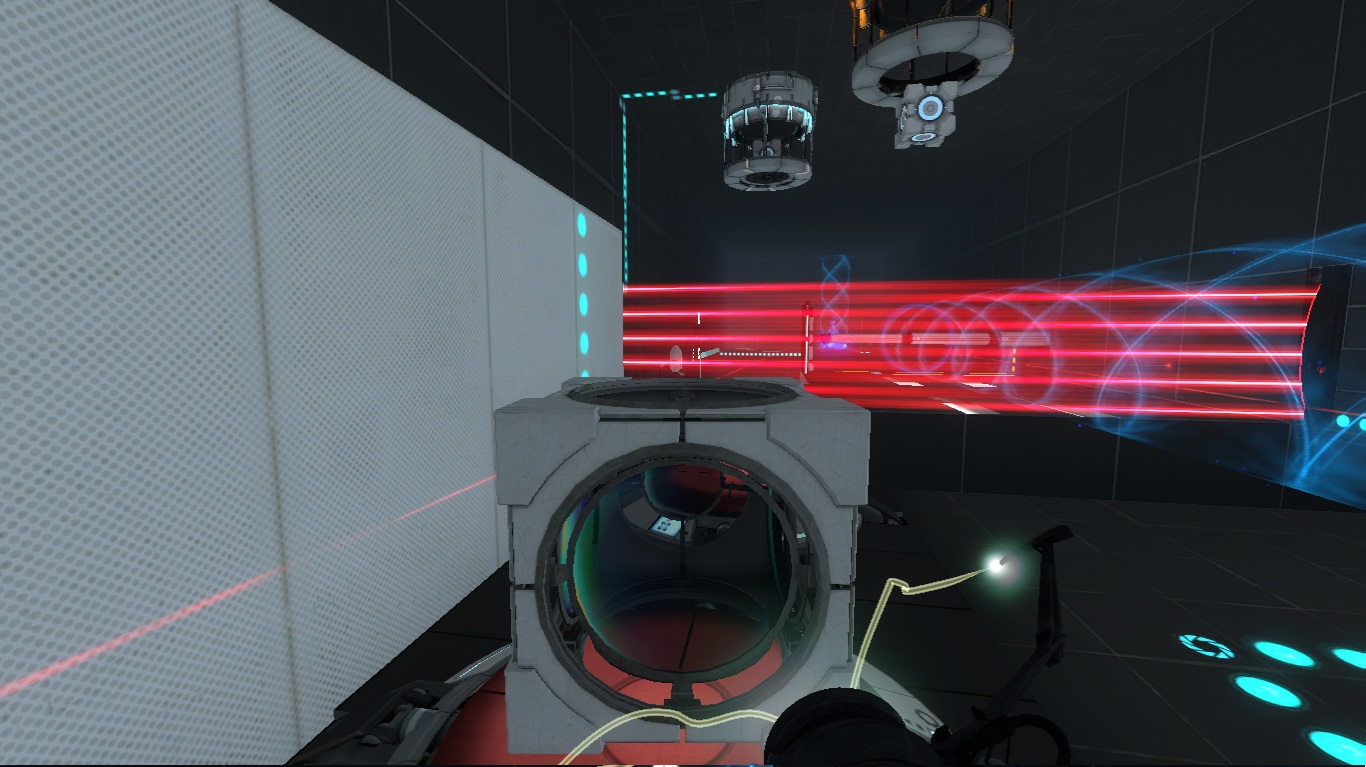
Laser gate on

The reason we do this is because that way it won’t confuse the player needlessly. Have a button be in viewing distance of what the result is going to do, or at least keep it close enough so that players will see the result without having to search too much. Having an obvious audio queue can also work but isn’t as effective. We need to provide the player some feedback on their actions otherwise it’s needlessly harder. If we want to make a puzzle harder, it should be because they need to think about how to solve a puzzle, not more difficult because they need to find out what your button did and where it dropped the cube.

Laser gate off. The button is in plain site of the laser field so it's easy to tell what the button did.

In my level, I’ve positioned all my buttons in such a way as if you look close to them, you will see the result immediately or soon enough. For example, a button will drop the cube right next to you, or will raise a bridge right in front of you.

_________________________________
Lead a path for the player

In other words, don’t make a giant room that doesn’t look like it has any particular order or requires a lot of back tracking. The reason we would want to lead the player is because we want them to get to our puzzles, this isn’t an adventure game. Now there is a limit as to how much we should lead the player, don’t point out everything for them, but point enough out for them to get somewhat of an idea of where to go. Don’t have three paths and in no sequential order scattered about.


The purpose for this game is for players to solve puzzles, not wander around like an adventure game. Though designers could attempt making a level like this, the main draw to playing portal is puzzles. Any moving around without doing any actual puzzle solving could be considered boring. Walking around to get to the end of the hall just isn’t fun.

The goal is in sight, all you need to do is figure out how to disable the threats in your way

For my level I lit up the path (This was actually a requirement for our levels) but I also made it very linear, you can actually see your final destination right away. I made it obvious where you need to be, you just have to figure out how to get past the obstacles in your way. Some key areas are also highlighted by lights though you still have to figure out how to solve the puzzle once you get there.

___________________________
Allow some mistakes

The player is going to make mistakes and we shouldn’t always punish them too terribly with them. One bad thing to do is make it so if players pass a certain point, but forget something they become permanently stuck and have to restart the level. This is especially terrible if there isn’t even much of a clue that continuing without a key object will end up this. I made a jump in one level to test and found out I became stuck at the bottom because I couldn’t portal to anywhere else.

For my level, it is possible to return all the way to the beginning if you dropped a cube

One debatable thing is the use of precision mistakes. For example I played a level where I had to use a reflection cube to aim a laser to a laser catcher to cross a bridge. If at any time the laser slipped off, the bridge would fall under me. Now this is difficult to cross and it’s a neat idea but for some players it can be frustrating because they know exactly what to do but one small slip up leads to restarting a level. This can lead to even more frustration if this is right at the end of a level meaning you have to do everything all over again because of that. If I were to use this in a level, I would just force them to restart the bridge, not restart the level. Either that or have a checkpoint right at that spot.

On the topic of checkpoints, one thing to do for a level is that if you plan to have a very dangerous area where players will die, try to keep it closer to the beginning rather than the end. This way if they make the mistake of dying, they will be able to retry as soon as possible rather than having to go through the same beginning puzzles over and over. Eventually that just becomes a chore because you already know how to solve everything at the beginning and have to keep doing it over and over.

Precision mistakes are minimal as the player is given the whole length of the level to try aiming this laser

How I used this in my level, you ride across a tractor beam throughout the level, spotting obstacles in the distance. You can also see these obstacles before riding the tractor beam too. I ensured that players could return to the beginning of the level by raising a bridge if they forgot anything important. To solve my puzzle, I also give you ample time and alternative ways to get to the finish so as to avoid players blaming precision mistakes. At the end of the level, you have to destroy some turrets with a laser beam and using a reflection cube. The farther back you start on the tractor beam the more time you have to target the turrets in your path. There is also a fairly wide window you have to destroy the turrets even if you start as far forward as possible.

_________________________________
Don’t have “Troll” buttons

Try not to have buttons that will screw over the player, especially into death. Don’t have a button that immediately kills a player for pressing it, unless it’s obvious that’s what the result will be. Don’t have buttons that randomly cause effects like that or put you at the beginning of a level unless you make it clear pressing it will have that effect. It will only serve to frustrate players and make the experience worse.

These two button (left) in my level used to be unhelpful. This has been rectified.

For my own level, I did in fact have a “troll” button, where activating it would not really help you. It wouldn’t kill you or set you back, but it wasn’t helpful either. Players in general will want to press the buttons and have them do an effect of some sort that will help. My buttons simply disabled the laser that would allow you to kill the turrets blocking you from the end of the level. Now I have it so pressing the buttons will instead activate the laser so that you can proceed. I made the button actually give some benefit for the player.

__________________________________
Get rid of anything useless

This one should be fairly obvious and it’s to make sure not to have any areas that look like they mean something, but they don’t actually do anything. So don’t have a bunch of buttons in an area but pressing them actually does nothing. It will only confuse the player even more, similar to the problem I mentioned earlier of having buttons who’s effects are obvious. Don’t have corridors that lead to nowhere either, they should be either a means to complete a puzzle or a way to get to another puzzle. This is similar to the troll button issue except these serve to waste time rather than frustrate the player.

The button behind this cube is given use to flip the turret in the distance. It may be a one time use, but it always benefits the player.

For my level, I got rid of any extra areas that weren’t needed. I had a small corridor that had a reflection cube but I got rid of the cube because I had already provided a reflection cube at the beginning of the level. Hence I made sure to get rid of the corridor later because it wouldn’t make the puzzle any better. I also made sure every one of my buttons did something meaningful. This is also part of the reason I changed the buttons that disabled the laser (noted in the trolling section), because they didn’t actually help you at all. You could get by without even touching them, which confuses a player even more.


Difficulty vs. Accesibility
Level beaten!

Everything I have said is relating to making everything easier to understand for players. It is my belief that it’s a very good practice. There is a reason that Portal & Portal 2 did so well in their campaigns despite them being brief. It’s because they were all very accessible, pretty much anyone could go through the game and enjoy it. They pretty much adhered to all the “What to do”s that I mentioned. Everything was clear and straight forward, the difficulty was in figuring out the puzzle, with no other issues in the way.

Think about it, if you suddenly had useless buttons, buttons that changed things in the level far away, way out of your sight then that’s just going to confuse and frustrate you right? That’s not confusion by logic, it’s just confusion to frustrate, it does not benefit the player experience in anyway. Sure it can promote observation but the key to making levels that will appeal to players is to make it accessible and it’s easily possible to keep observation too.

That’s the point of good level design to draw in players, to make them want to play even if it’s difficult. You want to make players like your levels and play through the game. If word gets out your game is broken, punishes players and is confusing in its level design, people don’t want to play. So making accessible, but difficult levels is really the best way to go. It’s simply good level design.

Sunday, September 23, 2012

Goals are the Spice for Games

Multiple game types are no strangers to games. Video games have been implementing multiple different modes for you to choose from since the very beginning. These can range from coop, to multiplayer and such but the most drastic thing to change are the goals to winning the game. The mechanics of the game remain intact (such as going from Campaign to Multiplayer) but the goals to winning have changed. No longer do you focus on getting to the end of the level and continuing the story. In multiplayer your goal can vary but the most common one is get the most kills, either solo or with your team.

Within the subset of multiplayer lies a vast array of different modes though, each with different goals. The same can be said for some singleplayer modes as well. The point is that changing the goal can affect how you play the game itself. 

In my Game Design class we did an activity for the purpose of looking at different goals in a single game. We played a coin tossing game essentially, with everyone having different goals. It was easy to see some people playing much differently, such as one person flicking coins to try and knock off others the whole time, while others were simply trying to flip coins to land on another coin to gain points. After seeing this activity I could really see how much goals can vary the gameplay.

For this post I'll take a look at various games and the other modes with different goals they offer and see how they change the experience. Let's first take a look at Left 4 Dead 2 and how a goal change in the game leads to different level design.

Left 4 Dead 2

Campaign mode vs Survival Mode

Left 4 Dead 2 is a survival horror shooter with cooperative gameplay in every mode it has. There is always a team you are with, you are never alone. If you decide to run alone you will be easily picked off by the infected. In the main campaign it has you and 3 other players trying to reach the end of the level. In the campaign, you move with your team from point A to point B, hoping to make it to the next checkpoint before dying. Simple enough, how pretty much every other campaign works in a shooter. 


Campaign mode: Beginning of the first level 'Crash'

However in the alternate mode survival, your goal is now to stay alive as long as you can with your team. Your goal is no longer to move from location to location but to simply hole up somewhere and give it your  best shot to stay alive. There is no winning in this mode, there is simply the satisfaction of getting the longest time alive in a level.

You still have access to the same items as you would in campaign but in terms of level design there are several changes.

  • In survival you are no longer forced to wander around or being forced to go to certain areas to proceed. You can stay in the same spot for as long as you want, but the catch is that the areas you can go are now limited. 
  • Survival mode takes place in much smaller areas and wandering off is not a wise. Another difference is that the amount of enemies is increased so surviving can actually become a daunting task.
  • You have unlimited supplies for ammo located in an unsafe spot (Depends on the map but typically its not easy to get back to supplies). Health packs are limited however
  • Special infected appear more frequently, especially Tanks.

Survival Mode - There is now a timer to show how long you've been surviving


With Survival mode, things have to be changed in terms of level design in order for the mode to work properly. Simply putting you in a campaign level and telling you to survive though it does change the goal won't actually make it fun. By changing a bit of the level design and rules slightly to fit with the now changed goal, it allows the mode to be significantly different to play then the campaign counterpart. Otherwise it would just be campaign mode with a slightly different shell which wouldn't be different, wouldn't give variety and wouldn't help the game.

By making a game mode with a different goal, it forced some aspects of the game's level design to change as a result to accomadate the goal. The experience is different and gives another way to play the game just because of a decision to change the goal of the game.

Let's take a look at another popular shooter with several different game modes.

Call of Duty

The Call of Duty franchise has had a wide array of game types (so have many other shooters) since the very beginning. Here I am going to outline three distinct game modes with very different goals from each other and methods of victory. Let's compare these modes which are Team Deathmatch, Domination and Search  & Destroy.

Multiplayer Modes

Team Deathmatch is the typical get as many kills for your team as you can. The first team to a certain number of kill is the winner.

Domination's goal is to hold 3 areas at strategic locations. These areas are always located in the same spot and once captured will give points to your team for every second they are under your control. They can be recaptured by enemy players. The team to get to the score limit first wins.

Search and Destroy is different than the other 2. For one you only have one life for a round and there are multiple rounds in a match. Teams alternate between defending and attacking. Attackers need to place a bomb and have it detonate, or kill the entire enemy team to win. Defenders need to run out the time limit (rounds are only a few minutes), defuse the enemy bomb if they planted it or kill the entire enemy team.

Comparing the Modes

So now let's compare them all shall we. Team Deathmatch has the most simple and typical goal, run around and kill as many people as you can. The most efficient method to achieving victory is to make sure you die less than you kill. This is typically considered the most "mindless" of the mode since it's not always necessary to think up advanced tactics to get a certain position.


Team Deathmatch - You can see the score required to win in the bottom left

Domination requires more thinking because you need to have people cover the areas you have captured as well as send in people to capture other points. Its a constant balance of keeping what you have and taking from the enemy. Since the goal is now different then Team Deathmatch, it becomes unadvisable to run around the edges of the map, far away from capture areas because that won't help to attain victory for your team.


Domination - Three locations A, B and C to capture and defend


Search and Destroy becomes far more challenging with a lot of varied goals all around in the mode. In order for these goals to become available (such as taking out the entire enemy team) some changes needed to be made. For taking out the enemy team, the rule of unlimited lives had to be changed to a single life to accommodate the rule. 


Search & Destroy - Attacking team planting the bomb

As can be seen, changing the goal to winning the matches presents themselves to very different gameplay styles. Some require less tactics to achieve the win, while others work a lot better with coordination and are much more punishing. Since some levels have objectives placed in certain areas, different levels can become signifcantly different to play. Such as for domination, which will differ much more in tactics due to different locations of capture points in maps then it would for Team Deathmatch.

 It can also be seen that for some goals they need to modify some core rules of the game in order to function properly for modes like Search and Destroy. Unlimited respawns would not work in a mode like Search & Destroy, though it could turn into a different game mode still involving the use of planting bombs. Those modes come in the form of demolition and sabotage.

Now that we've seen how goals can change how everyone has to coordinate together, let's take a look at another game which allows multiple goals to achieve victory.

Age of Empires II


In Age of Empires II, as an RTS you have the option of selecting from a variety of different victory conditions (goals). There is a selection of standard victory as well as alternative victory conditions. You can win any standard game with any of the following Standard Victory conditions.

Standard Victory

  • Conquest : Defeat all opponents. To defeat an opponent destroy all their units and buildings.
  • Wonder Victory: Build a wonder (Takes a ton of resources to make) first and keep it for a set amount of time to win.
  • Relic Victory: Control all relics on the map. These can be taken into and stored into monasteries by monks. Keep them all for a set amount of time to win.
You can complete any of these during the course of a standard match which means you have three potential ways to achieve victory. You can also opt to force everyone to only be able to use one type of victory when creating a game. So you can make a conquest only victory game, or Wonder only, etc.

Alternative Victory

  • Timed Victory: Have the highest score at the end of a certain time, or defeat opponents before then.
  • Score victory: Reach a certain score first. Score is determined by resources gathered, buildings and units built, map exploration, etc.
For these alternative goals, they use a system to calculate score based on the value of your units, buildings, research, resources, units killed and map exploration.

How these Victories make the game different


A Wonder- This is one way to achieve victory in a normal match

It's interesting in a standard game where you can try to opt for any one of the three standard victory conditions. It means you players can decide a tactic that best fits their strengths and their position in the map. They could try defensive via using a Wonder, or explorer by looking for all the relics, or even opt for offensive by going all out to try and destroy everyone. 

This system really appeals to players of all sorts of styles because a defensive player who likes to make a really strong castle would be at a disadvantage in a conquest only mode. They can use their wonder as a chance to obtain victory by staying in their base. And likewise it gives offensive players the chance to go and stop that Wonder camper by destroying everything in their base. Its a very flexible system that shows how giving multiple goals in a single match can cater to players. This also shows how having different goals will promote different styles of play.


Monastery - This can be used to store relics located around the map and is another way to achieve victory

The score system also lends itself to a slightly different style of play. You would still want to be using winning strategies to outsmart the other player but if things draw to a standstill or go to long, there is a chance you can still win by alternative means like exploring the map while one player stays inside their base. Having this different win condition can change your tactics on the fly.

So as can be seen, even with different goals, the base mechanics of the game didn't have to change. The resource collection rate hasn't changed or anything like that, or your unit creation limit isn't changed. The goals are the only thing that will differ which by themselves will make you play the game differently.  And that's the point of goals, to change how you play a game and promote variety and refreshing strategies.

How Goals change the game

Goals can vary in the way they influence the game. As can be seen in COD's Search and Destroy mode, it sometimes require some core rule changes (no respawning) in order to work properly. In Age of Empires II's case, they didn't even require core rule changes.

Whether they change the core rules or not they promote changing the way you play. It makes you think different, aim for things that you wouldn't do in a different mode. The purpose behind multiple goals and game modes is variety, to cater to different playstyles and give different experiences to players.  Sometimes you make the goal the same for everyone, othertimes you allow everyone to win in different ways. The choice in doing that lends itself to allow the game system to used to it's full potential and provide a larger amount of ways for players to enjoy themselves. Not everyone enjoys the same game type, so multiple modes is a great way for players to choose how they want to play and match up with others that want to do that mode as well.

This is how I've seen different goals affect the games I play!

Wednesday, September 19, 2012

Basket-Ball - Game Design Class Activity Breakdown


Game Design and Production has never shied away from doing class participation though always to various extremes. Today was the most involving and interesting class activity in a while. Usually class activities are with small groups of around 5 or so, but this time it involved splitting the entire class into 2 very large groups.

The objective was for each group to make a game within around 25 minutes and had the following guidelines…
  • You have 1 ball
  • Objective: Get the ball into a basket
  • Use whatever you want in the room to help with the rules of the game

To set some perspective on the environment we were in, it was a large room, with about 8 rows of long desks extending across the room. Here is a picture to show the room we were in and how we could use.


Our group demonstrated our game first while the 2nd group did so afterwards. I will put it out there that they were interesting for the time given to make them but overall they were pretty bad games.


1st Game – Chaos Bounce

Rule overview

The group I was a part of. For our game we made it a team based sport with 5 players on each team. The goal still is to get the ball in with one team starting with the ball in possession.
  1. Teams are to position their players around the field strategically before the match begins. They were allowed to stay on top of the desks.  
  2. An important thing to note is that players cannot move from their initial spot. They are allowed to take a step out but leave a foot behind as well as move their hands to block but they cannot take a real step out. The only time they can move is when they have the ball in possession, and are allowed 3 steps. 
  3. This makes it important to pass the ball around as you won’t be able to score if someone is blocking your way. An important thing to note about passing is that when passing you must bounce the ball on a surface first to your teammate. Fairly to do so was not actually given a consequence yet but you just weren’t supposed to.
  4.  If somehow a player misses passing the ball, since no one can move from their spot, it will automatically go to the closest player.
  5. One final rule is that players cannot position themselves too close to the basket so that they cannot easily dunk the ball in.
  6. An added rule near the end was for every player to take a chair and choose a position to place it on the tables around so that it could prove to be an obstacle and block other players.

Players must always bounce the ball when passing


Problems with the game

Breaking down the game, it became pretty obvious it was similar to handball and basket ball. The handball rule of only moving a certain amount when holding the ball applied with our rule #1. The basketball aspect came from rule 3, bouncing the ball. However it was obvious it was a very static and rather boring version of those games due to the fact that no one else can really move except for the player holding the ball. It makes the game a lot slower as repositioning will only happen when another player manages to get the ball and they really cant move too far.

Another problem lies with rule 4, which sends it to the closest player. It should have been automatically given to the other team because the passing team made a bad throw and should be punished. Otherwise they could simply throw it really far, reaching their teammate on the edge and being out of reach of anyone else so they can automatically get the ball.

The whole positioning of the game is interesting but honestly really slow and boring. A player could literally stand there and never get the chance to do anything in the game. Nor can they make “good plays” by getting into position at a good moment. This is like a turn based bored game with some interaction between players, not what a game with a ball should really be like.

Chairs as an obstacle were there but didn't really matter all that much


What could be improved

In a game like this, you really need to have some control over your movement, either that or the rules needed to be changed because it would have just become handball. Games with static movement in a physical sport are not generally as fun as those that have some movement. The idea of positioning is neat, but it needed to have just a bit more movement because if you never got the ball, you were pretty much stuck.

There were also simple rule changes that could have made the game better but weren’t put in time to be applied to the game, such as the ball going out of the reach of players.

Conclusion

For a game made in 25 minutes though, it isn’t bad but it wasn’t particularly fun either. I volunteered for testing the game though only with 3 on 3. It was honestly not interesting because I never once got the chance to get the ball due my position. I already went over the problems with positioning but honestly it just wasn’t too fun.  It looked like it had potential due to the positioning of chairs and people, however people on the edge of the area just couldn’t do as much as people closer to the basket.

2nd Game – Human Foosball

Rules Overview

The game made by the 2nd group, I honestly didn’t hear all the rules but the basic gist of it was human foosball. For some reason both of our groups decided that we should have minimal movement in this game and be stuck in the same position for most, if not the entire game. With their game, you could not move at all, no matter what, you stayed in the same position.

The basket was placed in the middle of the field, where it was surrounded by members of the two teams in foosball like positions. They litered all the rows of the area, (not allowed on the tables) with around 10 or more players on each team. They essentially slapped the ball, trying to get it into the basket. It was simply mindless hitting into the center which looked kind of fun and intense at times but overall was as static as our game.

Problems with the Game

People in certain positions hardly ever got to see the ball or get a chance to hit it, which in all honesty doesn’t look like too much fun. Since they were forced to stay still in that position, it made players in the center the most likely to hit the ball and have the most fun, while players on the outer edges got it far less frequently. There was a lack of balance in who got to hit the ball the most due to these positions so the fun factor was not equal.

Another problem was that players would often hit the ball out of boundaries which slowed down the game since they had to go pick it up.

The Legendary Game Design Ball

What could be improved?

It was honestly an interesting idea but if the game allowed for a bit more movement then it would have been better. Something I would have done to add to the fun was to allow some limited player movement. Players should be able to move around a bit in their row, a limited distance but not running into other players (if they happen to be in the same row). This would allow players to be more mobile and have a shot at being able to hit the ball to where they need to.

The basket was also located too close to players, if they were farther back they it would have allowed for more shots on the net that weren’t blocked by players. It would have given an opportunity for more scoring. The demo by the other group had no one scoring in the timeframe they were given.

Conclusion

This game was even less mobile than our game which I don’t find to be that good of an idea. It definitely looked chaotic like our game but I noticed a good portion of people who rarely were able to hit the ball. The idea was interesting but seemed to lack in fun factor for those on the edges.


The goal behind this activity

Both games used a mix of level design and Game Design. We created the rules but then we fit those rules and mechanics into the field we were to use, which is the goal of level design. I can tell that both groups thought more so about the game design aspect then the level design aspect. Though the rows of desks were incorporated, the only other level design that came about from the activity was for my group, (Chaos Bounce) which incorporated chairs into it to make more dynamic levels.

There has been a lot of emphasis on level design these past lectures so I believe it would have been more beneficial if we had put a bit more interesting design into the use of the room. Group 1 (Chaos Bounce) however had better use then group 2 (Human Foosball) so my group wins!